
In this article
For the first few months on Mounjaro, the scale often moves steadily. Then, one week, it stops. Then it stops again the next week. Most people’s first thought is that the medicine has stopped working.
It usually has not. Plateaus are an expected part of treatment, and many of the causes are things you can check and change. This guide walks through how to tell a real plateau from normal fluctuation, why it happens, and what genuinely helps.
Plateaus Are an Expected Part of Treatment
In the main tirzepatide weight-loss trial, SURMOUNT-1, average weight loss continued for many months and then gradually levelled off toward the later part of the 72-week study. Nobody in those trials lost weight in a straight line forever, and nobody in real life does either.
Every body reaches a point where intake and energy use come back into balance at a new, lower weight. Shorter stalls along the way are common too, often lasting a few weeks before loss resumes.
A stall is information, not failure
A plateau tells you something has changed, your body, your dose, or your habits. The useful response is to find out which, not to cut food drastically.

Is It Really a Plateau?
Day-to-day weight can swing by a kilogram or more with no change in body fat. Before deciding anything, make sure you are looking at a trend rather than noise.
| Looks like a plateau | Usually a real plateau |
|---|---|
| One or two weeks with no change | Three to four weeks with no change in your weekly average |
| A jump after a salty meal, a late dinner or a long flight | No change across normal weeks |
| Weight up around your period | Stable across a full cycle |
| Constipation: common on GLP-1 medication | Regular bowel movements and still no change |
| Scale stuck but waist or clothes getting looser | Scale, waist and clothes all unchanged |
Weigh at the same time, in the same conditions, a few times a week, and compare weekly averages. Measure your waist monthly. If the waist is falling while weight holds, you may be losing fat and keeping muscle, which is a good result.
Why Weight Loss Stalls on Mounjaro
- 01A smaller body needs less energyAs weight falls, the energy your body uses each day falls with it. Portions that produced steady loss at the start may simply maintain you now.
- 02Your body adaptsBeyond the drop from being smaller, the body becomes more efficient after weight loss and appetite signals strengthen. This is a normal response, not damage.
- 03Intake creeps back upAs side effects settle, eating often drifts upward without being noticed, an extra chai with sugar, a handful of namkeen, larger rotis, weekend meals out.
- 04Appetite returns late in the weekSome people notice hunger rising in the day or two before their next injection, and that is where extra eating gathers.
- 05Muscle loss lowers energy useIf protein or resistance training has been low, lost muscle reduces how much you burn at rest.
- 06Dose stageThe 2.5 mg starting dose is mainly there to let your body adjust, not for maximum weight loss. A stall at a low dose often has a different answer from a stall at a high one.

Check These First
Before changing anything, run through this list honestly. In our experience, one or more of these explains most stalls.
- Food log for seven days: written down or photographed, including drinks and tastes while cooking
- Liquid calories: sweetened chai and coffee, juices, lassi, smoothies and alcohol add up quickly and do not fill you up
- Protein: are you reaching your target at each meal, or mostly eating carbohydrate because it is easier?
- Missed or late injections: and whether you take it on the same day each week
- Pen storage: stored as the pack directs, and never left in a hot car or bag
- Sleep: short or broken sleep raises appetite and makes snacking far more likely
- New medicines: some steroids, antidepressants, antipsychotics and diabetes medicines can affect weight; never stop them without your healthcare provider
- Movement: has daily activity fallen as you started feeling less hungry or more tired?
Two conditions worth ruling out
An underactive thyroid and PCOS can both make weight loss harder. If you have symptoms such as tiredness, feeling cold, or irregular periods, ask your healthcare provider whether testing is appropriate.
Is a Dose Increase the Answer?
Sometimes. Mounjaro is usually increased in 2.5 mg steps, no faster than every four weeks, up to a maximum of 15 mg. In SURMOUNT-1, higher doses produced more weight loss on average, so if you are on a lower dose and tolerating it well, your healthcare provider may consider stepping up.
But a higher dose is not automatically the right answer.
| A dose increase may make sense when | It may not be the answer when |
|---|---|
| You are on a lower dose and tolerating it well | Side effects at your current dose are already hard to manage |
| The food and habit checks above are genuinely in order | Intake has crept up and has not yet been addressed |
| Hunger is clearly returning between doses | You are already on the highest dose |
| Your healthcare provider agrees further loss is medically worthwhile | You may have reached a healthy, sustainable weight |
Dose changes are a prescribing decision. Do not increase your dose, or take injections more often, on your own.
What Actually Helps
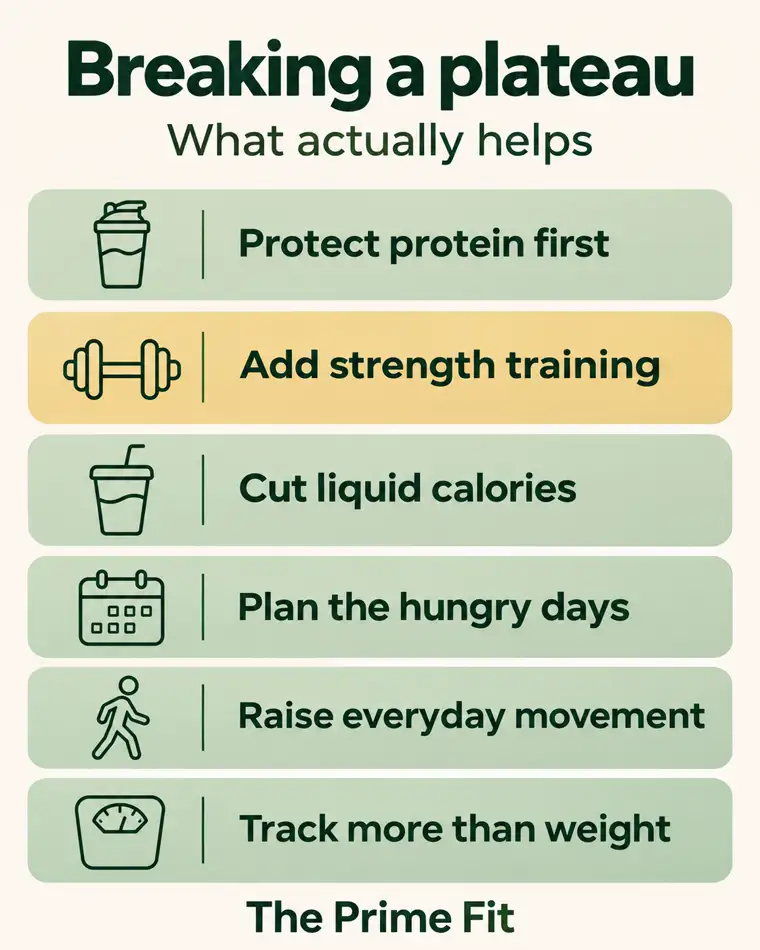
- 01Protect protein firstProtein at every meal keeps you full and protects muscle, which protects your metabolic rate.
- 02Add or progress strength trainingTwo or more sessions a week. If you already train, gradually increasing the load gives the body a reason to keep muscle.
- 03Cut liquid calories before foodSwitching to unsweetened chai and dropping juices is often the easiest meaningful change.
- 04Plan the hungry daysIf appetite rises before your next injection, plan higher-protein, higher-fibre meals for those days in advance.
- 05Raise everyday movementSteps, stairs and walking after meals add up, and they matter more as your body gets smaller.
- 06Track more than weightWaist, body composition and how clothes fit show progress the scale hides.

What Not to Do
- Do not slash food drastically, very low intake speeds muscle loss and makes the eventual regain worse
- Do not skip meals to compensate for a stall; it tends to lead to larger meals later
- Do not buy unregulated “tirzepatide” or compounded products online to take extra, quality and dose cannot be trusted
- Do not judge progress by a single weigh-in
When to Speak to Your healthcare provider
Book a review if any of these apply:
- No change in weekly average weight or waist for six to eight weeks despite the checks above
- Side effects are stopping you from moving up a dose
- Hunger is back to pre-treatment levels
- You have symptoms that could suggest a thyroid problem or another medical cause
- You are losing confidence or motivation and thinking about stopping
A plateau is one of the most common reasons patients join our GLP-1 support programme a fresh look at food, training and dose often gets things moving again.
Key takeaways
- Plateaus are expected on Mounjaro, trial data show weight loss levelling off over time.
- Look at weekly averages and waist over three to four weeks before calling it a plateau.
- Common causes include a smaller body needing less energy, intake creep, liquid calories and muscle loss.
- Run the checklist before changing anything, most stalls have an explanation you can fix.
- A dose increase can help, but it is a prescribing decision and not always the right answer.
- Do not crash-diet to break a stall; protect protein and strength training instead.
Frequently asked questions
Why has my weight loss stopped on Mounjaro?
Common reasons are that a smaller body needs less energy, the body adapts after weight loss, eating creeps back up as side effects settle, liquid calories, and muscle loss. Your dose stage matters too. Most stalls have an explanation that can be checked.
How long does a Mounjaro plateau last?
Short stalls of a few weeks are common and often resolve on their own. If your weekly average weight and waist have not changed for six to eight weeks despite good habits, it is worth a review with your healthcare provider.
Is Mounjaro no longer working for me?
Usually not. A plateau typically means your body has reached a new balance at a lower weight. Trial data show weight staying down while people remain on treatment, even after loss levels off.
Should I increase my Mounjaro dose?
Possibly, if you are on a lower dose, tolerating it well and your habits are in order. Doses are usually increased in 2.5 mg steps no faster than every four weeks, up to 15 mg. It is a decision for your prescriber.
Can I lose weight on 2.5 mg of Mounjaro?
Some people do, but 2.5 mg is mainly a starting dose to help your body adjust. A stall on the starting dose is not unusual and does not mean the medicine will not work for you.
Should I eat much less to break a plateau?
No. Drastic restriction speeds muscle loss and lowers your metabolic rate, which makes regain more likely. Protecting protein, cutting liquid calories and adding strength training work better.
Does exercise help break a Mounjaro plateau?
Yes. Resistance training protects muscle, which protects how much energy you burn at rest, and everyday movement matters more as your body gets smaller.
Could a medical condition be causing my plateau?
Sometimes. An underactive thyroid, PCOS and some medicines can make weight loss harder. If you have other symptoms, ask your healthcare provider whether testing is appropriate.